Introduction
DevSecOps transformed how organizations build and release software. Security moved closer to development, infrastructure became programmable, and CI/CD pipelines became the backbone of modern engineering.
But there is another challenge that many organizations still handle manually:
Governance, Risk, and Compliance (GRC).
Security teams may automate vulnerability scanning, secrets detection, infrastructure deployment, and policy enforcement—yet compliance evidence is often collected through spreadsheets, screenshots, emails, tickets, and last-minute audit exercises.
This creates a paradox:
The organization may be continuously secure, but it is not continuously audit-ready.
The next evolution of DevSecOps is therefore not simply “more security automation.”
It is Automated GRC—where compliance requirements become machine-readable policies, controls are continuously evaluated, evidence is automatically collected, and audit readiness becomes an always-on capability.
1. Traditional DevSecOps Has a Blind Spot
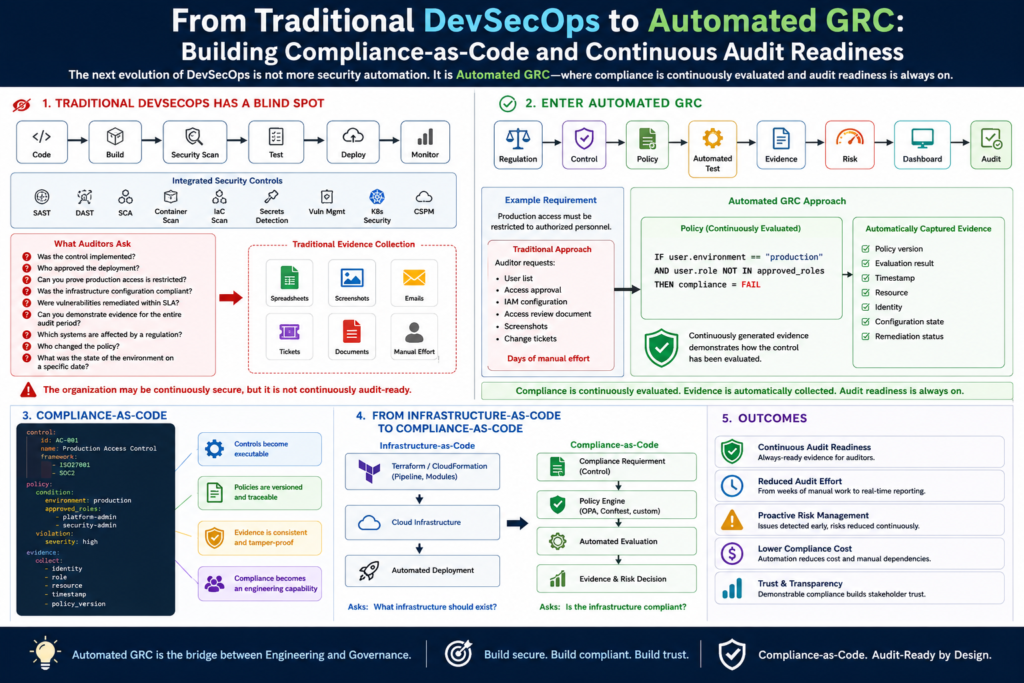
A typical DevSecOps pipeline may look like:
Code → Build → Security Scan → Test → Deploy → Monitor
Security controls can be integrated into each stage:
- SAST
- DAST
- SCA
- Container scanning
- IaC scanning
- Secret detection
- Vulnerability management
- Kubernetes security
- Cloud security posture management
However, auditors often ask different questions:
- Was the control implemented?
- Who approved the deployment?
- Can you prove that production access is restricted?
- Was the infrastructure configuration compliant?
- Were vulnerabilities remediated within the required SLA?
- Can you demonstrate evidence for the entire audit period?
- Which systems are affected by a particular regulation?
- Who changed the policy?
- What was the state of the environment on a specific date?
The engineering pipeline may know the answers.
The problem is that the evidence is often not automatically organized for the auditor.
2. Enter Automated GRC
Automated GRC connects engineering automation with governance and compliance automation.
Instead of treating compliance as a periodic activity, the organization treats compliance as a continuously evaluated engineering capability.
The conceptual architecture becomes:
Regulation → Control → Policy → Automated Test → Evidence → Risk → Dashboard → Audit
For example:
Requirement
“Production access must be restricted to authorized personnel.”
Traditional approach
An auditor requests:
- User list
- Access approval
- IAM configuration
- Access review document
- Screenshots
- Change tickets
The organization spends days collecting evidence.
Automated GRC approach
A policy continuously evaluates:
IF user.environment == "production"
AND user.role NOT IN approved_roles
THEN compliance = FAIL
The system automatically captures:
- Policy version
- Evaluation result
- Timestamp
- Resource
- Identity
- Configuration state
- Remediation status
Now the organization does not merely say:
“We are compliant.”
It can demonstrate:
“Here is continuously generated evidence showing how the control has been evaluated.”
3. Compliance-as-Code
The central idea behind Automated GRC is Compliance-as-Code.
Compliance requirements are translated into executable policies.
Instead of keeping controls only inside documents, spreadsheets, and GRC platforms, organizations express them in machine-readable form.
For example:
control:
  id: AC-001
  name: Production Access Control
  framework:
    - ISO27001
    - SOC2

policy:
  condition:
    environment: production
    approved_roles:
      - platform-admin
      - security-admin

  violation:
    severity: high

evidence:
  collect:
    - identity
    - role
    - resource
    - timestamp
    - policy_version
The exact implementation can vary, but the architectural principle remains the same:
Controls become executable.
4. From Infrastructure-as-Code to Compliance-as-Code
Most cloud-native organizations already understand Infrastructure-as-Code.
For example:
Terraform
      ↓
Cloud Infrastructure
      ↓
Automated Deployment
Compliance-as-Code extends the same philosophy:
Compliance Requirement
        ↓
Machine-Readable Control
        ↓
Policy Engine
        ↓
Automated Evaluation
        ↓
Evidence
        ↓
Risk Decision
This creates an important shift.
Infrastructure-as-Code asks:
What infrastructure should exist?
Policy-as-Code asks:
What infrastructure is allowed to exist?
Compliance-as-Code asks:
Can we continuously prove that the infrastructure satisfies our required controls?
These three capabilities together create a much stronger governance model.
5. Continuous Audit Readiness
Traditional audits are often treated as projects.
For example:
Audit begins → Evidence collection → Interviews → Remediation → Auditor review → Audit closes
This creates tremendous operational pressure.
Continuous audit readiness changes the model:
Control → Automated Test → Evidence → Monitoring → Exception → Remediation
The organization continuously maintains an evidence trail.
When an auditor arrives, the team is not starting from zero.
The evidence already exists.
6. The Automated GRC Architecture
A modern architecture can be structured into several layers.
Layer 1 — Regulatory Intelligence
Sources may include:
- ISO 27001
- SOC 2
- PCI DSS
- NIST
- GDPR
- DORA
- HIPAA
- Internal security policies
- Customer contractual requirements
These requirements are mapped into organizational controls.
Layer 2 — Control Library
The organization creates a reusable control library.
Example:
CTRL-IAM-001
Privileged access must use MFA.

CTRL-LOG-001
Security logs must be retained for the required period.

CTRL-ENC-001
Sensitive data must be encrypted at rest.

CTRL-VULN-001
Critical vulnerabilities must be remediated within SLA.
Controls become reusable building blocks.
Layer 3 — Policy Engine
Policies evaluate real infrastructure and application data.
Potential technologies include:
- Open Policy Agent
- Rego
- HashiCorp Sentinel
- Kyverno
- Cloud-native policy engines
- Custom policy engines
Layer 4 — Evidence Collection
Evidence can be automatically collected from:
- AWS
- Azure
- Google Cloud
- Kubernetes
- GitHub
- GitLab
- CI/CD systems
- IAM systems
- Databases
- SIEM platforms
- Vulnerability scanners
- Ticketing systems
- Endpoint security platforms
Layer 5 — Evidence Store
Evidence should be:
- Timestamped
- Immutable where appropriate
- Traceable to a control
- Associated with a resource
- Associated with a policy version
- Retained according to requirements
This creates an audit evidence graph.
Layer 6 — Risk Engine
Not every violation has the same business impact.
The risk engine can combine:
Control Failure + Asset Criticality + Business Impact + Exposure + Regulatory Impact
to produce a risk score.
For example:
Critical Production System
        +
MFA Disabled
        +
Internet Exposure
        +
Privileged Account
        =
Critical Risk
7. DevSecOps + GRC = DevSecOps 2.0
Traditional DevSecOps focuses heavily on:
Security of the software delivery lifecycle.
Automated GRC expands this into:
Security + Governance + Risk + Compliance + Evidence
The pipeline could become:
Developer Commit
      ↓
SAST
      ↓
SCA
      ↓
Secret Scan
      ↓
IaC Security
      ↓
Compliance Policy
      ↓
Build
      ↓
Deployment
      ↓
Runtime Compliance
      ↓
Continuous Evidence
      ↓
Risk Evaluation
Now compliance is embedded into the same engineering lifecycle.
8. Shift-Left Compliance
Security shifted left.
Now compliance must shift left too.
Instead of discovering compliance violations after deployment:
Design → Validate → Deploy
For example, Terraform could be checked before infrastructure reaches production.
Terraform Code
      ↓
Security Scan
      ↓
Compliance Policy
      ↓
Policy Decision
      ↓
Approved / Rejected
A non-compliant resource should ideally never reach production.
This creates preventive compliance rather than merely detective compliance.
9. Runtime Compliance
Pre-deployment controls are not enough.
Infrastructure changes after deployment.
Cloud resources change.
IAM permissions change.
Containers change.
Kubernetes configurations change.
Therefore:
Compliance must continue after deployment.
A runtime compliance engine can continuously evaluate:
Cloud Resources
Kubernetes
IAM
Network
Databases
Applications
Logs
Configurations
against organizational policies.
This provides:
Continuous Compliance Monitoring
rather than:
Periodic Compliance Assessment
10. AI Can Transform Automated GRC
Generative AI and agentic AI introduce another layer.
An AI-powered GRC system can help interpret regulatory requirements and connect them with technical controls.
For example:
Regulation
     ↓
AI Regulatory Analyst
     ↓
Control Mapping
     ↓
Policy Generation
     ↓
Policy Validation
     ↓
Automated Testing
     ↓
Evidence Collection
     ↓
Risk Analysis
An AI agent could answer:
“Which systems are currently failing controls related to privileged access?”
The system could query multiple sources and generate:
12 systems affected

4 critical
5 high
3 medium

Primary causes:
- MFA configuration
- Excess privileges
- Missing access review
The AI should not replace human governance.
Instead, it should reduce the manual effort required to understand and operate the compliance environment.
11. The Rise of the Compliance Engineer
This evolution creates a new engineering role:
Compliance Engineer
A Compliance Engineer sits between:
Security + Cloud + DevOps + Risk + Audit
The role requires understanding:
- Cloud architecture
- DevSecOps
- Infrastructure-as-Code
- Policy-as-Code
- Kubernetes
- IAM
- Security controls
- Regulatory frameworks
- Risk management
- Evidence automation
- APIs
- Data engineering
- AI-assisted automation
This is fundamentally different from traditional compliance work.
The future compliance professional will increasingly need to understand technology.
And the future security engineer will increasingly need to understand governance.
12. Skills Required for the Transition
For a DevSecOps engineer moving toward Automated GRC, the learning path can be:
Stage 1 — DevSecOps Foundation
Master:
- Git
- CI/CD
- Docker
- Kubernetes
- Cloud
- Terraform
- Security scanning
- Secrets management
Stage 2 — Governance
Learn:
- Risk management
- Control frameworks
- ISO 27001
- SOC 2
- NIST
- PCI DSS
- Regulatory mapping
Stage 3 — Policy-as-Code
Learn:
- OPA
- Rego
- Kyverno
- Sentinel
- Cloud policies
Stage 4 — Evidence Automation
Learn how to collect evidence through:
- Cloud APIs
- Kubernetes APIs
- IAM APIs
- CI/CD APIs
- SIEM APIs
- Security-tool APIs
Stage 5 — GRC Integration
Connect technical controls with:
- Risk registers
- Control libraries
- Exceptions
- Findings
- Remediation
- Audit evidence
Stage 6 — AI-Augmented GRC
Finally introduce:
- LLMs
- RAG
- Agentic AI
- Regulatory document analysis
- Control mapping
- Evidence summarization
- Risk analysis
- Compliance assistants
13. A Practical Enterprise Example
Imagine a financial organization deploying a new application.
Traditional process:
Developer
   ↓
DevOps
   ↓
Security Review
   ↓
Compliance Review
   ↓
Audit Evidence
   ↓
Production
This creates bottlenecks.
Automated GRC changes the workflow:
Developer
   ↓
CI/CD
   ↓
Security Tests
   ↓
Compliance-as-Code
   ↓
Policy Evaluation
   ↓
Automated Evidence
   ↓
Risk Decision
   ↓
Production
   ↓
Continuous Monitoring
The compliance team moves from manually checking every deployment to governing the policies and exceptions.
That is a major operating-model transformation.
14. Metrics That Matter
Organizations adopting Automated GRC should measure more than the number of controls.
Useful metrics include:
Compliance Coverage
Automated Controls / Total Controls × 100
Evidence Automation
Automatically Generated Evidence / Total Evidence × 100
Audit Preparation Time
Measure how long it takes to prepare for an audit.
Mean Time to Compliance
How quickly can a violation be detected and remediated?
Policy Coverage
What percentage of critical cloud resources are continuously evaluated?
Exception Aging
How long do compliance exceptions remain unresolved?
Continuous Compliance Score
Percentage of evaluated resources passing applicable controls.
These metrics transform GRC from a documentation function into an engineering capability.
15. The Business Value
Automated GRC can provide several business benefits.
Lower Audit Cost
Less manual evidence collection.
Faster Audits
Auditors can access structured evidence faster.
Reduced Compliance Risk
Violations can be detected continuously.
Faster Cloud Adoption
Organizations can introduce cloud services with automated guardrails.
Better Security
Compliance controls can reinforce security controls.
Faster Remediation
Violations can automatically generate tickets or remediation workflows.
Better Executive Visibility
Leadership receives real-time visibility into compliance posture.
16. What the Future Looks Like
The future architecture is moving toward:
Policy
  ↓
Code
  ↓
Infrastructure
  ↓
Runtime
  ↓
Telemetry
  ↓
Evidence
  ↓
Risk
  ↓
AI Analysis
  ↓
Automated Remediation
This is more than compliance automation.
It is an autonomous governance feedback loop.
Imagine a production resource becoming non-compliant.
The system detects it.
Then:
- Identify the violated control.
- Identify the affected asset.
- Calculate business risk.
- Generate evidence.
- Create a remediation ticket.
- Recommend remediation.
- Apply approved remediation.
- Re-test the control.
- Update the evidence.
- Notify stakeholders.
That is where GRC begins to behave like an engineering system.
17. The Career Opportunity
For DevSecOps professionals, this transition represents a significant career opportunity.
Instead of positioning yourself only as:
DevOps Engineer
or:
DevSecOps Engineer
you can evolve toward:
Cloud Security Architect
→ DevSecOps Architect
→ Security & Compliance Architect
→ Automated GRC Architect
→ AI Governance & Risk Architect
The combination of Cloud + DevSecOps + Security + Compliance + AI is particularly powerful because it connects technical implementation with business and regulatory requirements.
Conclusion
DevSecOps taught organizations how to integrate security into software delivery.
The next step is to integrate governance and compliance into the same engineering lifecycle.
The destination is not another dashboard.
It is an organization where:
Every important control is measurable.
Every important policy is executable.
Every important decision is traceable.
Every important violation is detectable.
And audit readiness is continuous.
The transition from traditional DevSecOps to Automated GRC is therefore not simply a tooling upgrade.
It is a change in mindset:
From compliance documentation → compliance automation
From periodic audits → continuous audit readiness
From manual evidence → machine-generated evidence
From policy documents → executable policies
From reactive remediation → preventive controls
From GRC as a separate function → GRC as an engineering capability
The organizations that master this transition will be better positioned for an environment where cloud, cybersecurity, AI, regulation, and operational risk are becoming increasingly interconnected.
And for DevSecOps engineers, architects, security professionals, and technology leaders, Automated GRC may become one of the most valuable next-generation career paths in enterprise technology.